


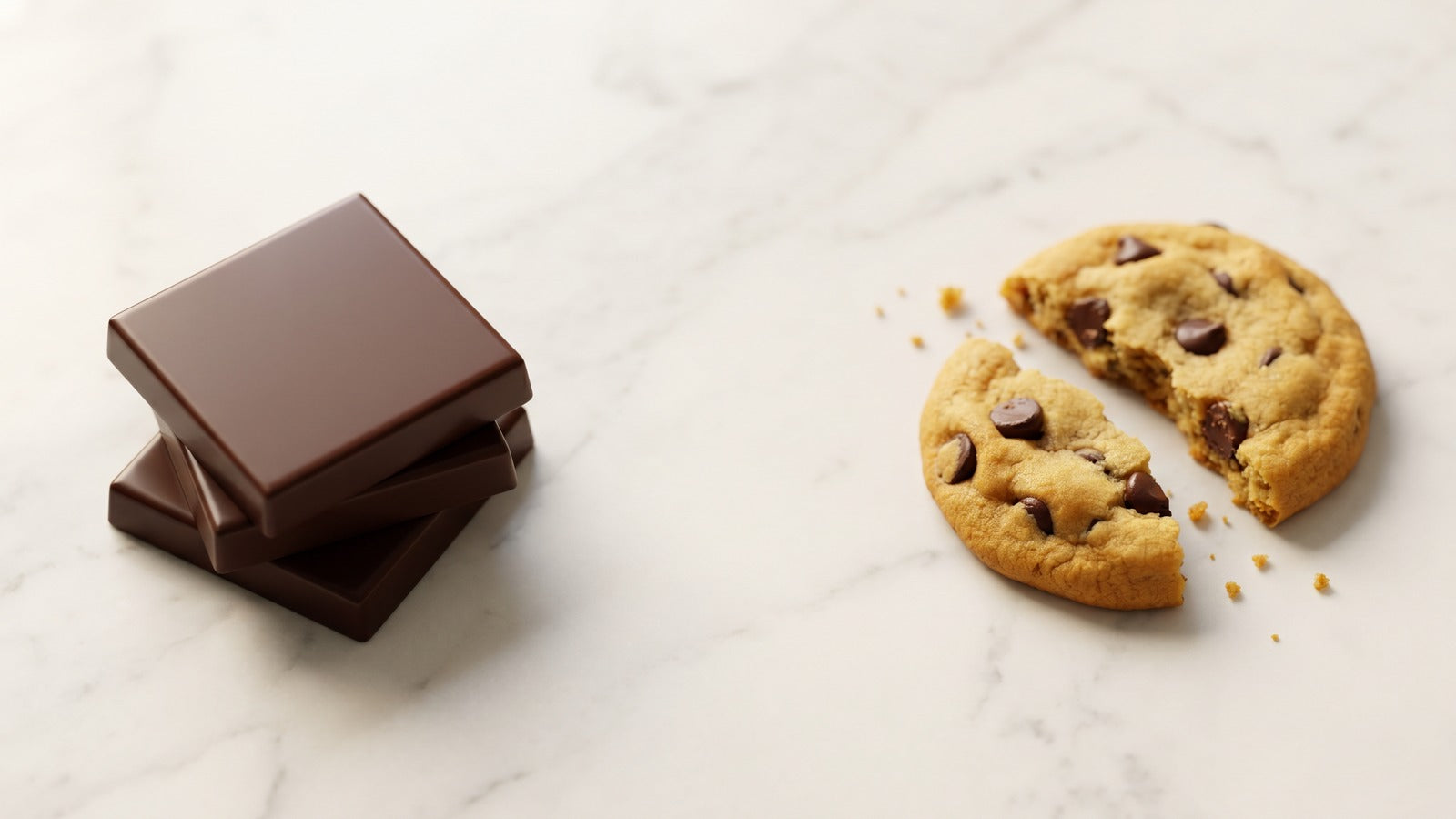
How Many Calories in a Chocolate Chip Cookie?

Chocolate Chip Cookie Calories: A Chocolate Maker's Honest Breakdown

A chocolate chip cookie usually runs 50 to 500+ calories. A medium homemade cookie sits near 70 to 80, a Subway cookie around 200, and a Panera or Starbucks cookie around 360 to 390. The single biggest driver is sugar and butter, not the chocolate.
Most articles about cookie calories come from a database. This one comes from a chocolate maker. We have spent eighteen years thinking about cacao percentage, sugar load, mouthfeel, and what a person actually wants when they say "I am craving a cookie." So when the question is how many calories are in a chocolate chip cookie, the honest answer is not a single number. It is a small set of numbers that depend on size, source, and what is inside the dough.
We are not here to lecture you. We love a great cookie too. But if you came looking for honest math (and maybe a thought about whether the cookie is really what you want), this guide gives you both: every brand and bakery number you actually need, the science of where the calories come from, and a calmer alternative for the days when chocolate (not the cookie) is the real craving.
Why a Chocolate Maker Is Writing About Chocolate Chip Cookie Calories
Most articles ranking for "chocolate chip cookie calories" come from generic nutrition databases or content farms. Their job is to feed you a number and move on. Ours is different: we make the chocolate that goes inside the cookie, so we have a direct stake in helping you understand which part of the cookie is actually driving the calories (spoiler: not the chocolate) and what a cleaner version of the same craving looks like.
If you are tracking calories because you are trying to eat less sugar, lift your protein ratio, or just stop the 3 PM crash, the cookie itself is rarely the right lever. The dough is the calorie engine. The chocolate is the flavor engine. Separate the two and you can keep what you love (the chocolate, the small ritual) without dragging in 200 to 400 calories of butter-and-flour matrix you did not specifically want.
So when our Smarter Swap section below recommends a couple of Coracao bars, it is not a banner ad slipped into a nutrition article. It is the actual answer to the question many readers are really asking, which is, "Is there a way to keep the chocolate moment without the cookie's calorie load?" Yes, and the rest of this guide explains how.
01How Many Calories Are in a Chocolate Chip Cookie?
The honest short answer: anywhere from 50 to over 500 calories per cookie. A standard medium homemade chocolate chip cookie (about three inches across, baked from a classic Toll House style recipe) lands at 70 to 80 calories. A mini cookie can be as low as 30 to 50. A gourmet bakery cookie can clear 400 to 500 easily, and a few specialty stuffed cookies push past 600.
Why the range is so wide
Three variables do almost all the work:
- Size and weight. Calories track grams of dough. Double the diameter of a cookie and you can roughly quadruple the calories, because area scales with the square and dough mass scales with volume.
- Fat and sugar ratio. A standard recipe is roughly half butter and sugar by weight, before flour. Bakery-style recipes lean heavier on both, which is what makes them richer and significantly more caloric.
- Source. Packaged brands are engineered to hit a serving-size calorie target. Coffee chains aim for indulgence (a single cookie meant to feel like a treat). Homemade sits in the middle, with full control over the recipe.
The takeaway: where the cookie came from matters more than whether it is "chocolate chip" or any other dough style. Two cookies with the same name can differ by 5x in calories.
02Chocolate Chip Cookie Calories by Size (Mini to Bakery)
If you bake your own, this is the table that matters. The numbers assume a classic chocolate chip cookie recipe (flour, butter, white and brown sugar, eggs, vanilla, salt, baking soda, semi-sweet chocolate chips) at a 1:1 dough ratio. Sub in dark chocolate or cut sugar by 25% and the same row drops 10 to 20 calories.
| Size | Approximate Calories |
|---|---|
| Small (2 inch diameter) | 60 to 100 calories |
| Medium (3 inch diameter) | 120 to 180 calories |
| Large (4 inch diameter) | 200 to 300 calories |
| Gourmet / bakery-style (4.5 inch and up) | 350 to 500+ calories |
A standard 3-inch homemade chocolate chip cookie typically contains around 70 to 80 calories when made with restrained portions of butter, sugar, and chips. The range widens fast when the recipe is "loaded" with extra chocolate or oversized scoops. If your kitchen scoop is bigger than 1.5 tablespoons of dough, you are probably baking 150 to 200-calorie cookies whether you mean to or not.
Sea Salt and Almond 81%
Salty, crunchy, deeply chocolatey. 81% dark with toasted almonds and flaky sea salt. The bar that converts cookie people to dark chocolate.
Shop sea salt bar →03Calories by Brand: Subway, Starbucks, Panera, and More
When people search "how many calories in a chocolate chip cookie", roughly half are really asking "how many calories in the specific cookie I just bought". Below is the cheat sheet across the chains and brands you actually encounter. Numbers are pulled from each brand's published nutrition data; we double-checked everything against a third-party database when available.
Fast-Food and Coffee Chain Cookies
| Source | Size | Approximate Calories |
|---|---|---|
| Subway | 1 cookie | 200 to 220 calories |
| Panera | 1 cookie | 380 calories |
| Starbucks | 1 cookie | 360 to 380 calories |
| McDonald's | 1 cookie | 170 calories |
| Chick-fil-A (Chocolate Chunk) | 1 cookie | 360 calories |
| Local bakery (average) | 1 medium cookie | 250 to 400 calories |
| Specialty bakery (gourmet) | 1 large cookie | 400 to 600 calories |
Sources: brand nutrition pages, cross-checked against CalorieKing, FastFoodNutrition, and Chick-fil-A's published menu.
The pattern is clear: coffee-shop cookies are roughly twice the calories of fast-food cookies, because they are physically bigger and built with richer dough. A Subway cookie at 200 calories is roughly the same size as a McDonald's cookie at 170; a Starbucks cookie at 370 is a different category of dessert entirely.
Packaged Grocery Brands
| Brand | Serving Size | Calories |
|---|---|---|
| Chips Ahoy! Original | 3 cookies | 160 calories |
| Chips Ahoy! Chewy | 2 cookies | 140 calories |
| Famous Amos | 4 cookies (1 oz) | 140 calories |
| Keebler Chips Deluxe | 2 cookies | 150 calories |
| Pepperidge Farm Chesapeake | 1 cookie | 140 calories |
| Tate's Bake Shop | 2 cookies | 140 calories |
| Oreo (not chocolate chip, but commonly searched) | 3 cookies | 160 calories |
Sources: nutrition panels on the official Chips Ahoy, Famous Amos, Keebler, Pepperidge Farm, and Tate's Bake Shop product pages, accurate at time of publishing.
Packaged brands lean small. A single Chips Ahoy is roughly 53 calories, and a single Tate's is around 70. That sounds low until you notice that a serving is two or three cookies, not one. Most people eat the serving (sometimes more), so the practical calorie load is in the 140 to 200 range, not 53.

04What's Actually in a Chocolate Chip Cookie? (the Macro Breakdown)
Calories are a useful number but they are not the whole story. A cookie is also a delivery system for sugar, fat, and a small amount of flour-based carbohydrate. Here is the average profile of a medium homemade cookie:
Macronutrient Breakdown (Average Medium Homemade Cookie)
| Nutrient | Amount |
|---|---|
| Calories | 70 to 80 calories |
| Fat | 3 to 5 g |
| Carbohydrates | 9 to 12 g |
| Sugar | 5 to 8 g |
| Protein | 1 g |
| Fiber | less than 1 g |
Store-Bought Cookie Nutrition (Chips Ahoy Original, 3-cookie serving)
| Nutrient | Amount |
|---|---|
| Calories | 160 calories |
| Fat | 8 g (3.5 g saturated) |
| Carbohydrates | 22 g |
| Sugar | 11 g |
| Protein | 1 g |
| Sodium | 110 mg |
Two things to notice. First, 11 grams of sugar in three small cookies is meaningful: that is about 22% of the American Heart Association's recommended daily added-sugar limit for women (25 g), or 17% for men (36 g). Second, protein and fiber are near zero, which is why one cookie often becomes three (no satiety signal to slow you down).
Factors That Push Calories Up
From inside a baking kitchen, here is how each ingredient moves the needle:
- Butter contributes the most calories per gram of any cookie ingredient (about 7 kcal/g). Recipes that use a full stick (4 oz) of butter to make 24 cookies are clocking roughly 33 calories per cookie just from butter.
- Sugar (white and brown together) is the next biggest lever. About 4 kcal/g, with bakery-style recipes often using 1 to 1.5 cups for a 24-cookie batch (roughly 35 to 50 calories of sugar per cookie).
- Chocolate chips matter, but less than people think. A standard semi-sweet chip is roughly 5 kcal each. 12 chips per cookie is about 60 calories. The cookie is mostly butter and sugar with chocolate as a topping.
- Flour type moves the needle slightly. Whole wheat flour adds a few calories per cup vs. all-purpose, plus more fiber.
- Add-ins (nuts, candy chunks, extra chocolate) easily add 30 to 80 calories per cookie. Pecans in particular are calorie-dense.
- Density and bake time. A dense, chewy cookie holds more dough per square inch than a thin crispy one, so it has more calories at the same diameter.
The honest reframe: when people say "cookies are bad for you," what they mean is "cookies are mostly sugar and butter, with a bit of chocolate." The chocolate part is the one ingredient with any real flavor complexity. Which is why the smarter swap below makes sense.
05Is 200 Calories a Lot for a Cookie?
Yes and no. 200 calories is on the higher end for a single cookie, but it is not catastrophic, and the calorie count alone is not the right question.
200 calories is roughly:
- 10% of a 2,000-calorie daily target
- The same as one medium banana plus a tablespoon of peanut butter
- About 30 minutes of brisk walking to burn
In isolation, that is fine. The reason a 200-calorie cookie matters is not the calories. It is the composition: about 11 to 14 g of sugar (a quarter to half of the daily added-sugar limit), almost no protein, almost no fiber, and a fast blood-sugar curve that tends to leave you hungrier 90 minutes later than before you ate it. The exact same 200 calories from Greek yogurt, fruit, or a handful of nuts would behave very differently in your body.
What actually matters is the sugar-to-protein ratio and what else you ate that day. A 200-calorie cookie after a balanced lunch is a non-event. A 200-calorie cookie at 4 p.m. on an empty stomach is the start of a hunger spiral. Same number, different context.
06Lower-Calorie Chocolate Chip Cookie Alternatives
If you want to keep the cookie habit but ease the calorie or sugar load, there are real options. We will not pretend these are health food (chocolate chip cookies are dessert), but the math does improve.
Lower-Calorie Store-Bought Options
- Chips Ahoy! Thin Crisps: roughly 140 calories per 6-cookie serving
- Tate's Bake Shop Tiny Tate's: roughly 150 calories per 11-cookie serving
- Annie's Organic Chocolate Chip Cookies: roughly 130 calories per 8-cookie serving
- Back to Nature Chocolate Chunk Cookies: roughly 130 calories per 2-cookie serving
"Thin" or "mini" versions are the simplest cut: same recipe, smaller pieces, the math just works out. The sugar density per gram is usually similar, so this is a portion strategy more than a recipe one.
Homemade Recipe Modifications
- Cut sugar by 25%. Most chocolate chip recipes can lose a quarter of the sugar without anyone noticing. The dough behaves the same; the cookies just taste a touch less sweet.
- Use applesauce. Replace half the butter with unsweetened applesauce to cut fat and calories. The texture turns slightly cakier; if you want chewy, only replace a quarter.
- Add oats. Rolled oats add fiber and let you use a bit less flour. Each cookie ends up more filling per calorie.
- Use real dark chocolate. A 70% to 80% chocolate has a more intense flavor, so you can use fewer chips for the same flavor impact. Sugar drops naturally.
- Bake smaller. A 1-tablespoon scoop instead of 2 tablespoons cuts each cookie's calories by about a third with zero recipe surgery.
Vegan, Gluten-Free, Keto Variations
Special-diet versions are not automatically lower in calories. Here is the honest summary:
- Vegan cookies swap butter for plant oils and eggs for flax. Calories track the original within 5 to 10%. A medium vegan chocolate chip cookie is still around 70 to 100 calories.
- Gluten-free cookies depend heavily on the flour. Almond flour-based versions run higher (90 to 120 calories per medium cookie) because almonds are calorie-dense. Rice flour or a GF blend tracks closer to regular flour.
- Keto cookies use sugar alcohols (erythritol, monk fruit) and almond or coconut flour. Sugar drops dramatically but calories often hold steady because the recipes lean heavier on fat. A medium keto cookie averages 90 to 120 calories.
"Free-from" does not automatically mean "lower calorie." Read the panel.
07The Smarter Swap: When Chocolate (Not the Cookie) Is What You Really Want
Here is the part of the article we have been working toward, and we will say it plainly: sometimes the craving is for chocolate, and the cookie is just the delivery vehicle. If that is true for you, the calorie math gets very interesting.

Two squares of high-cacao dark chocolate against one coffee-shop cookie is roughly: a third of the calories, a quarter of the sugar, and almost three times the actual cacao. The cacao is what your taste buds (and frankly your serotonin) were after in the first place. The cookie was the wrapper.
Why High-Cacao + Low-Sugar Satisfies Faster
When chocolate is 70% cacao or higher, three things change inside one bite:
- The flavor compounds are denser. A square of 81% chocolate releases more aromatic volatiles (the fruity, floral, slightly bitter notes that make chocolate taste like chocolate) than a chip's worth of semi-sweet inside a buttery dough matrix.
- The fat is cocoa butter. It melts at body temperature, coats the palate, and signals "rich" to the brain. That signal is sensory satiety; it tells you to stop sooner than a cookie does.
- The sugar curve is calmer. Less sugar plus more fat plus a touch of fiber from cacao mass means a slow, level energy rise instead of a spike-crash. You stay satisfied longer.
This is not theory; it is a known feature of how the palate responds to high-cacao chocolate. Two well-made squares hit harder than they have any right to, calorie for calorie.
Three Coracao Picks for the Swap
If you want to try the swap, these are the three Coracao bars that solve different versions of "I am craving a cookie":

Our 99% sugar-free dark chocolate bar is the calorie minimalist's answer to a cookie. Almost pure cacao, zero refined sugar, fair-trade heirloom beans. Two squares cost roughly 110 calories with under 1 g of sugar.
When you really want the cookie because you want something rich, our sea salt almond 81% dark chocolate answers the call. Roasted almond plus flaky sea salt mimics the salty-sweet-crunchy register a cookie hits. Around 130 calories per two-square serving.

If a cookie's crunch is what you actually miss, our sugar-free crunch chocolate is the closest textural analog we make. Crisped quinoa inside a creamy plant-based bar, no refined sugar. Around 120 calories per two-square serving.
None of this is a moral judgment on cookies. It is just an option. The next time the craving hits, ask yourself whether you want a buttery, sugary dough situation or whether you want chocolate. The honest answer changes which choice makes you happiest.
How to tell a great dark chocolate from a mediocre one
- Clean snap when broken at room temperature, no chalky bloom on the surface
- Cacao percentage listed, ideally 70% or higher for the flavor swap to work
- Cocoa butter, not vegetable fat, in the ingredient list
- Short ingredient panel: cacao, sugar, cocoa butter, vanilla, salt, and not much else
- Single-origin or fair-trade if you can swing it, the flavor is meaningfully more layered
08Bake Smarter: 5 Coracao Ingredients That Cut the Calorie Load
If you bake your own cookies (the single biggest lever for sugar control), the four most impactful ingredient swaps live inside Coracao's pantry shelf. Swap one or two and you trim 15 to 40 calories per cookie without losing flavor. Swap all five and you essentially have a different (better) cookie.

Shave or chop into your dough instead of semi-sweet chips. Pure cacao, zero sugar, deep flavor. Saves roughly 20 calories and 5 g of sugar per cookie.

Replace 30 to 50 percent of dairy butter with cacao butter. Same melt-in-the-mouth richness, no dairy, adds a subtle chocolate note. Roughly equivalent calorie-wise but cleaner fat profile.

Stir 1 tablespoon into your dough for a deeper-chocolate cookie that needs less sugar overall. Raw cacao, unsweetened. Lets you drop the sugar in the recipe by about 2 tablespoons.

Use 1:1 in place of brown or white sugar. Slightly lower glycemic load, a soft caramel note, and a calmer blood sugar curve than refined white sugar.

Add 1 tablespoon to vegan cookie recipes for a creamier, chewier texture without dairy. Holds the bake together when you skip eggs.
The fastest start: replace chocolate chips with chopped Pure Organic Cacao Paste, and swap white sugar 1:1 with organic coconut sugar. Two swaps, same recipe time, roughly 30 to 50 fewer calories per cookie and a deeper, less sweet flavor.
09Enjoying Chocolate Chip Cookies Mindfully
If cookies are what you want, eat the cookie. The goal is not abstinence; it is awareness. A few habits worth keeping:
- Savor slowly. The first bite is always the best bite. Eating a cookie in three bites instead of seven gives you about half the calories of the cookie-after-this-one.
- Pair with protein. A glass of milk (dairy or plant), a few nuts, or Greek yogurt extends satiety and softens the sugar curve.
- Plan it in. If you know dessert is coming, eat slightly less at lunch. Don't catastrophize after the fact; the total day matters more than any one moment.
- Quality over quantity. One great cookie beats four mediocre ones, every time, on both pleasure and total intake.
- Bake your own when you can. You control the sugar, the butter, the size, and the chocolate. A homemade 1-tablespoon cookie with 70% dark chocolate is around 60 calories and tastes better than most things in a vending machine.
The Ritual Move
One last thought from the chocolate-maker side of the desk: if you find yourself reaching for a cookie at the same time every afternoon, the craving is often less about hunger and more about ritual. A cup of unsweetened drinking chocolate (cacao, water, a little plant milk) does the same job: warmth, comfort, a real pause. Two squares of dark chocolate on the side, optional. The whole thing costs about 150 calories, scratches the same itch, and lasts longer than the cookie did.
10Frequently Asked Questions
How many calories are in one chocolate chip cookie?
A standard medium homemade chocolate chip cookie (about 3 inches across) runs roughly 70 to 80 calories. A small (2-inch) cookie is 60 to 100 calories, and a large (4-inch) cookie is 200 to 300. Packaged store-bought cookies average 50 to 75 calories per cookie. Bakery and coffee-shop cookies, which are larger and richer, sit in the 250 to 400 range.
How many calories are in a homemade chocolate chip cookie?
Homemade cookies usually come in at 70 to 80 calories for a medium 3-inch cookie made from a classic recipe with butter, white and brown sugar, and semi-sweet chips. If you cut sugar by 25%, use dark chocolate instead of semi-sweet, or scoop smaller (1 tablespoon instead of 2), you can land at 50 to 65 calories per cookie. Loaded bakery-style homemade cookies (extra butter, extra chips, jumbo scoop) can climb to 200 to 350 calories each.
Is 200 calories a lot for a cookie?
200 calories is on the higher end for a single cookie but not catastrophic. It is about 10% of a 2,000-calorie daily target, roughly the same as a medium banana plus a tablespoon of peanut butter. What matters more than the calorie number is the composition: a 200-calorie cookie typically carries 11 to 14 grams of sugar with almost no protein or fiber, which is why it does not satisfy hunger the way 200 calories of yogurt or nuts would. Context (what else you have eaten that day) decides whether it is a non-event or a problem.
How many calories are in a Subway, Starbucks, or Panera chocolate chip cookie?
Subway cookies run roughly 200 to 220 calories. Starbucks chocolate chip cookies are around 360 to 380 calories. Panera chocolate chip cookies are roughly 380. McDonald's chocolate chip cookies are 170 each, and Chick-fil-A's Chocolate Chunk cookie is about 360. The pattern: coffee-shop cookies are roughly twice the calories of fast-food cookies, because they are bigger and built with richer dough. All numbers are pulled from each brand's published nutrition data and cross-referenced with CalorieKing and FastFoodNutrition.
Are chocolate chip cookies bad for you?
"Bad" is the wrong frame. A chocolate chip cookie is dessert. It is mostly butter, sugar, and flour with a small amount of chocolate, and it carries no meaningful protein, fiber, or micronutrients. Eaten occasionally, that is fine. Eaten daily and in large portions, the sugar load (often 10 to 25 g per cookie) starts to matter for blood sugar, weight, and dental health. The honest take: enjoy them, savor them slowly, and don't make them a daily ritual at the office-pantry scale.
What is the healthiest chocolate chip cookie?
The "healthiest" cookie depends on what you optimize for. For lowest calories, look at thin-style packaged cookies (Tate's Bake Shop, Chips Ahoy Thin Crisps, Annie's Organic) at roughly 60 to 75 calories per cookie. For lowest sugar, homemade with 25% reduced sugar plus dark chocolate chunks is the cleanest move. For best ingredient quality, organic options like Annie's or a bakery using real butter and high-cacao chocolate (instead of palm oil and milk-chocolate coating) are clear winners. If you actually want the chocolate satisfaction with the calorie load of a healthy snack, two squares of high-cacao dark chocolate (around 110 calories, under 5 g sugar) does the job better than any "healthy cookie".
How many chocolate chip cookies can I eat in a day?
There is no medical maximum; the question is what the cookies are displacing. One medium cookie (70 to 80 calories, 5 to 8 g sugar) inside a balanced day is essentially a rounding error. Three or four medium cookies (or one giant bakery cookie) is roughly a quarter of an average daily calorie target and most of an adult's recommended added-sugar limit, so the rest of the day's food needs to compensate. The American Heart Association suggests women keep added sugar under 25 g per day and men under 36 g, which is a more useful guardrail than counting cookies.
Does dark chocolate make a cookie healthier?
Slightly, and not for the reason most people think. The chocolate itself is a tiny fraction of the cookie's total calories (roughly 60 calories of 12 chips out of a 200-calorie cookie). Swapping semi-sweet chips for 70% to 80% dark chocolate trims a few grams of sugar per cookie and adds a bit of flavanol content, which is real but small at typical cookie portion sizes. The bigger health win, if that is what you are after, is to skip the dough entirely some of the time and just eat the dark chocolate. Two squares of an unsweetened 99% bar or an 81% sea salt almond bar delivers more cacao and less sugar than a cookie ever will.
The honest swap
If you have read this far, you already know what we make. Two squares of high-cacao dark chocolate, a third of the sugar, almost three times the actual cacao. The cookie can stay in your life. So can the chocolate-only afternoon, the kind that hits the same craving and leaves you steadier afterward.
Shop Coracao chocolate barsMore Coracao chocolate
Maker-direct bars and pantry staples. Single-origin cacao, no refined sugar shortcuts.
- 99% cacao, zero added sugar
- USDA Organic, Fair Trade
- ~30 mg natural caffeine / oz
- 81% dark, single-origin cacao
- Toasted almonds, flaky sea salt
- Salty-sweet crunch in every bite
- Plant-based milk chocolate
- Crisped quinoa, no wheat
- Sugar-free

Claire Bennett
I'm Claire, a chocolate lover and artisan based in a small town where I run a tiny home kitchen dedicated to exploring everything chocolate. From single-origin dark bars to creamy ganache and handmade truffles, I find joy in working with all types of chocolate. I believe chocolate has a story, and I love bringing that story to life through humble, heartfelt creations.

Leave a comment
This site is protected by hCaptcha and the hCaptcha Privacy Policy and Terms of Service apply.