


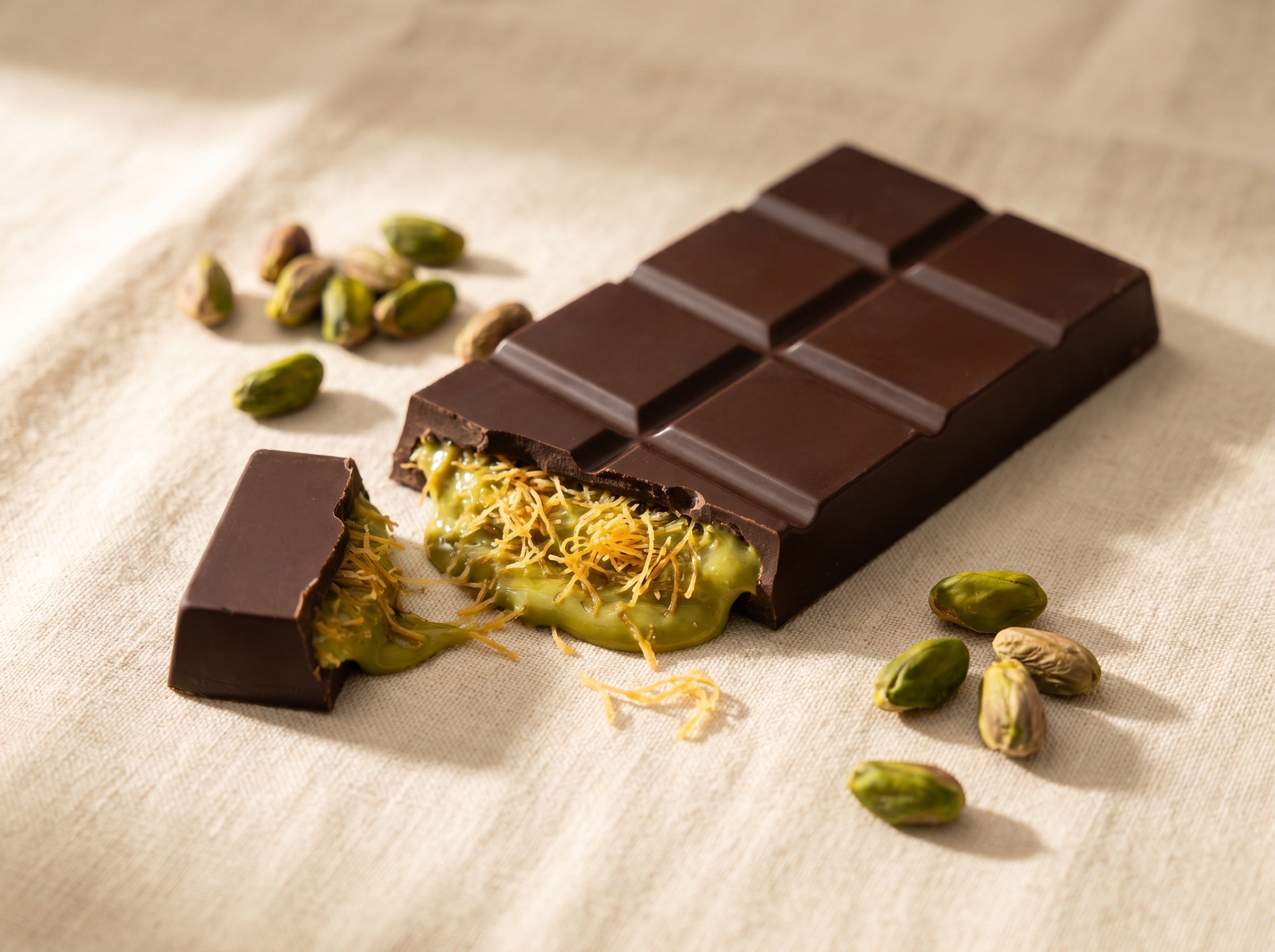
Dubai Chocolate Ingredients: The 4 Essentials

Dubai Chocolate Ingredients: The 4 Essentials, Where to Buy Them, and How to Use Them

Dubai chocolate is built from four pantry-cousins working in harmony: a quality dark or milk chocolate shell, a creamy pistachio paste, crisp toasted kataifi (shredded phyllo), and a quiet spoonful of tahini. Get those four right, and the bar takes care of itself.
If you have been watching the Dubai chocolate phenomenon and finally want to actually make one yourself, welcome. This is the sourcing guide we wish someone had written for us. Not the cultural backstory, not the brand history of Fix Dessert Chocolatier, not the TikTok timeline. The hands-on, label-reading, where-do-I-actually-find-this version.
Four ingredients sounds simple, and on paper it is. In practice, two of them (kataifi and good pistachio cream) live well outside the average American grocery aisle, the third (tahini) shows up in eight wildly different qualities, and the fourth (chocolate) has more wrong answers than right ones. We will walk every one down to brand and substitute level, then show you the prep steps that actually matter once you have everything in your kitchen.

Why Coracao Wrote a Dubai Chocolate Ingredients Sourcing Guide
Most search results for "Dubai chocolate ingredients" send you to recipe blogs that have never actually toasted kataifi or tempered a shell. We are a stone-ground organic chocolate maker in California who started making our own Dubai-style bar in 2024 after a steady stream of customers asked, "Do you have anything like Fix?" So we ran the experiment in our own kitchen, in real production volumes, and learned exactly where the home version falls apart. This guide is what we wish we had read before we started.
If you are sourcing ingredients to make Dubai chocolate at home, the four-ingredient stack is misleading. The chocolate shell alone has more substitution decisions than the other three combined: cocoa percentage, sweetener, dairy versus vegan, single-origin versus blend, and whether you can temper it yourself or need a couverture that does the heavy lifting for you. That is where our pantry products specifically help, because they are the ingredient-grade halves of a finished bar.
So when we suggest a Coracao pantry shortcut later in this article, it is not a banner ad. It is the result of running these exact ingredients through our own production process and telling you which substitutions actually move the needle on flavor, shelf life, and texture.

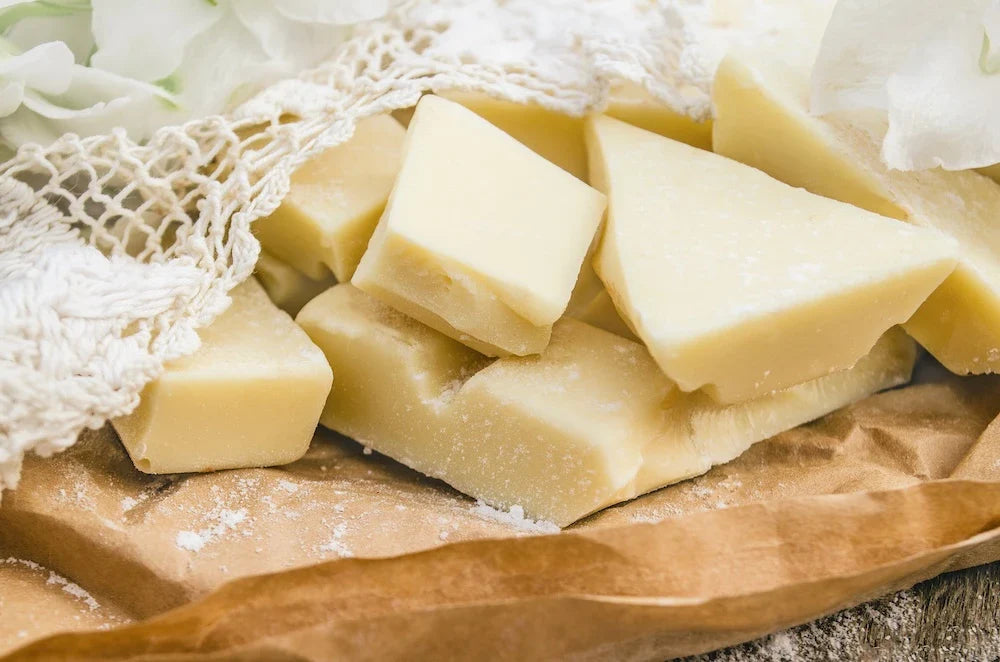
Organic Cacao Butter
Raw, fair-trade, single-origin. Use it to toast the kataifi for a cleaner, dairy-free finish and a bar that stays audibly crisp days longer. Two jobs in one: shell tempering fat and toasting fat.
Shop cacao butter →01The 60-Second Refresher: What Dubai Chocolate Actually Is
Dubai chocolate is a thick, palm-sized bar with a chocolate shell wrapped around a soft pistachio filling that has been laced with crisped strands of toasted phyllo and seasoned with a spoonful of sesame paste. The original, made by Fix Dessert Chocolatier in Dubai under the name "Can't Get Knafeh of It," is a love letter to knafeh, a Levantine dessert built on the same shredded phyllo, sweet syrup, and nut filling.
When you break a good one in half, three things happen at once: the chocolate snaps cleanly, the green pistachio cream pulls between the halves like the strings on a slice of pizza, and your ear picks up the dry crackle of toasted kataifi. That sensory event is the whole point. Source the four ingredients well and you will recreate it. Cut a corner on any one of them and the bar reads as a thicker-than-usual candy bar, which is not what you came for.
If you want the full cultural backstory, including how a pregnancy craving turned into a TikTok-fueled global pistachio shortage, that lives in the companion explainer. From here on out we are inside the pantry.
02The Four Essentials, Up Close
Here is the entire shopping list, photographed flat on white marble: a wedge of dark chocolate, a jar of pistachio cream, a bottle of tahini, and a bundle of kataifi. Four ingredients, four sourcing decisions, four ways to either lift or sink the final bar.

1. The Chocolate Shell
The shell is the largest single component by weight, the first flavor you taste, and the last one that lingers. It carries every other ingredient, so a waxy or one-dimensional chocolate poisons the whole bar regardless of how good your pistachio cream is. This is the ingredient where "use what you have in the cupboard" almost always backfires.
What to look for on the label:
- Real cocoa butter listed in the ingredients, not "vegetable fat" or "palm kernel oil." Cocoa butter is what gives the bar its snap and the silky mouthfeel that melts at body temperature.
- A short ingredient list. Premium chocolate, dark or milk, has 4-6 ingredients. If you are seeing 11 lines with PGPR, soy lecithin in two forms, and three artificial flavors, that is a coating product, not a chocolate.
- Cocoa percentage stated. For Dubai chocolate, 60-72% dark or 35-45% milk works best. Below that range, the bar reads as cloyingly sweet next to the rich pistachio. Above 75%, the bitterness fights the filling instead of supporting it.
- Single-origin or fair-trade certified when possible. This is the line between a bar that tastes like generic candy and a bar that tastes like a place.
Brands that work for home use: Valrhona Caraibe 66%, Callebaut 811 (54%), Guittard 64%, and any couverture-grade bar from Trader Joe's "Pound Plus" Belgian line if you want to stay under $10/lb. For a fully vegan, USDA Organic shell, Coracao's own bars are designed exactly for this kind of melt-and-mold project. Whichever you pick, weigh out 340 g (12 oz) for a two-bar batch.
Where to find it: Whole Foods, World Market, Williams Sonoma during the holidays, any well-stocked baking aisle, or online via the manufacturer's own site. Avoid candy-coating melts and "chocolate-flavored" anything; they will not temper, they will not snap, and they will not taste like chocolate.
2. Pistachio Cream (The Star)
This is the ingredient most home cooks underestimate, then over-correct. Pistachio cream is not pistachio butter, and it is not Nutella with green coloring. Done right, it is a smooth, scoopable paste built from ground pistachios, a neutral oil to loosen, a small amount of sugar, and sometimes milk powder (or coconut cream in vegan versions). The signature green is natural to the nut when it is ground with skins on.
What to look for on the label:
- Pistachios listed first, ideally above 40% of the jar. "Pistachio paste" with sugar as the leading ingredient is candy spread, not what you want.
- An olive-leaning, slightly muted green. The neon green you see on viral TikToks is usually food coloring or chlorophyll dye. The real thing reads more like a sage or matcha than a highlighter.
- Iranian, Turkish, or Sicilian pistachios in the source line. These three origins ship the best flavor profile, with Sicilian Bronte at the top of the price ladder and Turkish Antep right behind.
- No artificial flavor. "Natural and artificial pistachio flavor" is a flag; real pistachios are flavorful enough on their own.
Brands that work: Mymouné Pistachio Spread (Lebanese, often at Whole Foods and Mediterranean grocers), Babbi Pistacchio (Italian, on Amazon), Bronte DOP Pistachio Cream (premium tier, $30+ per jar), and the various Costco-stocked private-label tubs that exploded after the trend hit. The closest "Fix Dessert Chocolatier" feel comes from a 50%+ pistachio Italian or Sicilian paste; the Bronte DOP is the gold standard.
Make-your-own option: 1 cup roasted unsalted pistachios + 2 tbsp neutral oil + 1 tbsp powdered sugar + pinch of salt, blended in a high-powered processor for 4-6 minutes until smooth. Cheaper than store-bought, more honest in flavor, and you control the sugar. The texture will be coarser than commercial versions, which works in this bar because the kataifi is bringing the crunch anyway.
Where to find it: Middle Eastern groceries are the first stop. Look in the refrigerated specialty section, not the nut-butter aisle, because pistachio cream is often shelved with halva and tahini. Online, Amazon and Sicilian importers like Gustiamo and Eataly carry the best jars. Costco has been stocking 32 oz tubs of pistachio cream specifically marked for Dubai-style bars; check the seasonal section.
3. Kataifi (The Crunch)
Kataifi, sometimes spelled kadayif or kadayıf, is the ingredient that turns a thick pistachio chocolate bar into Dubai chocolate. It looks like a nest of thin vermicelli noodles and behaves like ultra-fine shredded phyllo, because that is exactly what it is. The dough is extruded through a perforated cup onto a hot surface, briefly cooked into pale strands, and packaged frozen.
What to look for on the label:
- Three or four ingredients only: wheat flour, water, a touch of oil, sometimes a little starch. Anything else is filler.
- Frozen or refrigerated, never shelf-stable for the best texture. Shelf-stable kataifi exists but tends to be brittle and harder to separate.
- Bright white to pale cream color. If it is already toasted or amber-toned in the package, you have lost half the prep step.
- Country of origin Greece, Lebanon, or Turkey. All three traditions make excellent kataifi; the variations are minor and mostly about strand thickness.
Brands that work: Apollo Kataifi (Greek, in any Whole Foods freezer), Athens Kataifi (the same parent company), Ziyad Kataifi (Lebanese, common in Arab groceries), and Kontos Kataifi (also Greek). All four are interchangeable for our purposes; pick the one your nearest store carries.
How to prep it: Defrost in the fridge overnight (do not microwave), then chop with kitchen scissors into 1-inch lengths. The chopping is non-negotiable because long uncut strands will rope through the filling and make slicing the finished bar miserable. Toast in a large skillet with 2-3 tablespoons of butter or coconut oil over medium heat, stirring every 30 seconds, until deep golden brown. This takes 8-10 minutes and the difference between gold and "almost gold" is the difference between a great bar and a soft one.
Gluten-free swap: Crisped quinoa, puffed rice cereal, or gluten-free phyllo (Geefree makes one). The texture is lighter than the original, which some people actually prefer. Coracao's bar uses crisped quinoa for exactly this reason, and it shatters as cleanly as wheat-based kataifi does.
Where to find it: Greek and Middle Eastern grocery stores stock it year-round in the freezer aisle. Whole Foods reliably carries Apollo brand. Online, Amazon ships Apollo and Athens nationwide, usually with two-day delivery. If your neighborhood has a Mediterranean bakery, that is the highest-quality source and often the cheapest.
4. Tahini (The Quiet Anchor)
Tahini is the ingredient that separates a Dubai chocolate that tastes like a complete dessert from one that tastes like flavored candy. A single spoonful does three jobs at once. It loosens the filling so it spreads cleanly inside the chocolate shell. It adds a savory, slightly bitter bass note that prevents the bar from reading as one-dimensionally sweet. And it deepens the perceived pistachio flavor by reinforcing its earthy, vegetal register.
If you have ever made a homemade Dubai-style bar that felt like it was missing something, the missing thing is almost always tahini.
What to look for on the label:
- One ingredient on the label: sesame seeds, nothing else. This is the quality marker premium tahini brands explicitly market — Soom, Seed + Mill, Al Arz, and Mighty Sesame all list just sesame seeds, no salt, no stabilizers.
- Hulled or unhulled stated. For Dubai chocolate, hulled tahini (milder, paler) works better than unhulled (more bitter, darker).
- Ethiopian, Lebanese, or Israeli sesame origin for the smoothest grind and the cleanest finish.
- A pourable consistency at room temperature. Tahini that has gone solid in the back of the fridge is fine, but if it was rock-hard in the store, it has likely been over-stored.
Brands that work: Soom Foods (Ethiopian sesame, made in Philadelphia, the chef's pick), Seed + Mill (single-origin, often in Whole Foods), Al Arz (Lebanese, the household standard across the Mediterranean), Mighty Sesame Co. squeeze bottles (convenient for small batches). Avoid the bigger commercial brands that pad with vegetable oil; you will taste it.
How much to use: 2 tablespoons per 200 g of pistachio cream is the sweet spot. More than that and the sesame takes over. Less than that and you might as well not bother. Some recipes call for 1 tablespoon; we have always found that under-doses the effect.
Where to find it: Every grocery store now carries at least one tahini, usually in the international aisle next to the hummus ingredients. Trader Joe's house-brand is acceptable if you cannot find a specialty option. For the best grade, Middle Eastern groceries and online specialty sellers (the Soom Foods site, Whole Foods online, Thrive Market) are the route.
Quick-check: are you holding good ingredients?
- Chocolate: snaps cleanly when broken cold, glossy on the surface, no chalky bloom
- Pistachio cream: sage-green or olive-green, not neon, with pistachios listed as the first ingredient
- Kataifi: bright white to pale cream in the package, frozen or refrigerated, three ingredients
- Tahini: one ingredient on the label, pourable at room temperature, single-origin if possible
03Optional Enhancements (Use Sparingly)
Once you have the four essentials, there is a small second tier of ingredients that show up in some recipes and on some viral bars. None of them are required, all of them are easy to find, and a few of them genuinely improve the final product.
White Chocolate Drizzle
Many of the most photographed Dubai bars show a green-tinted white chocolate drizzle on top, which is decorative more than it is structural. Two to three tablespoons of melted white chocolate, a drop of green gel food coloring, brushed across the molds before the dark chocolate goes in. When you unmold the finished bar, the drizzle becomes the top design. Skip it and the bar is still excellent; add it and your finished bar looks like the version your friends saw on Instagram.
Sea Salt
A small pinch of fine sea salt (Maldon flakes work, but kosher salt is fine) folded into the pistachio cream tightens the flavors and prevents the bar from reading as flat. This is one of the few "should I add this" decisions where the answer is always yes. About 1/4 teaspoon per 200 g of filling.
High-Quality Butter (or Coconut Oil for Vegan)
For toasting the kataifi, the fat carries flavor directly into every strand. European-style butter (Plugra, Kerrygold, Vermont Creamery) browns more evenly and adds a hazelnut undertone. For a fully plant-based version, virgin coconut oil works almost identically and adds a subtle tropical note that pairs well with the pistachio.
A Note on Color
If your pistachio cream is on the muted side and you really want the neon-green look, a single drop of gel food coloring is the cleanest fix. We do not recommend it (the muted green is the authentic look) but it is a real choice many makers make. Liquid food coloring will thin the filling; use gel only.
05How to Source and Prep Dubai Chocolate Ingredients
Sourcing the ingredients is half the work. Prepping them so they cooperate inside a finished bar is the other half. This is the part most online recipes hand-wave, and it is where the home version of Dubai chocolate either lands the texture or doesn't.
- Buy and chill the chocolate. Pick a 60-72% dark or a 35-45% milk couverture with real cocoa butter in the label. Bring it home, keep it sealed at room temperature (not in the fridge, which can cause bloom), and weigh out 340 g (12 oz) for a two-bar batch the day before you build.
- Source pistachio cream and let it warm to room temperature. Open the jar 30 minutes before you start working. Cold pistachio paste is stiff and refuses to fold; room-temperature pistachio paste behaves like soft peanut butter and combines cleanly. Stir gently before measuring out 200 g (7 oz).
- Defrost and chop the kataifi. Move the package from freezer to fridge the night before. The morning of, dump 140 g (5 oz) onto a board and chop with kitchen scissors into roughly 1-inch strands. Separate the clumps with your fingers so every strand can toast evenly.
- Toast the kataifi until it reads "deep gold." Melt 2 tablespoons of butter (or coconut oil) in a wide skillet over medium heat. Add the chopped kataifi, stir often, and cook for 8-10 minutes. The color you want is not "light gold" or "starting to brown," it is the color of toasted sesame, dark amber, nearly the color of caramel. Take it off heat and let it cool fully (10 minutes) before mixing into the filling.
- Combine the filling. In a medium bowl, fold the cooled kataifi into the pistachio cream, then add 2 tablespoons of tahini and a pinch of sea salt. Use a flexible spatula and fold (do not stir aggressively) until evenly streaked. The mixture should feel scoopable but not loose, like a thick cookie dough.
From here, the chocolate work begins. Temper your chocolate (melt to 45°C / 113°F, cool to 27°C / 81°F, gently warm back to 31-32°C / 88-90°F), brush a thin layer into silicone bar molds, press the filling in leaving a 2 mm margin, and seal with more tempered chocolate on top. Refrigerate for 30 minutes, unmold, store in an airtight container.
If "temper your chocolate" reads like a foreign sentence, you are not alone, and the technique is its own rabbit hole. The short version: real tempering gives you snap and shine, but you can also fake it with a "seeding" method (melt two-thirds of your chocolate, take it off heat, stir in the remaining third in small pieces, keep stirring until it cools to 32°C). For a deep-dive on tempering with cacao butter, that's a conversation for another article.
06The Coracao Pivot: When You Want the Bar Without the Project
Here is the honest part. Sourcing four specialty ingredients, defrosting and toasting kataifi, tempering chocolate, owning silicone molds, and dedicating an afternoon to it all is wonderful when you have the time. It is also a lot.
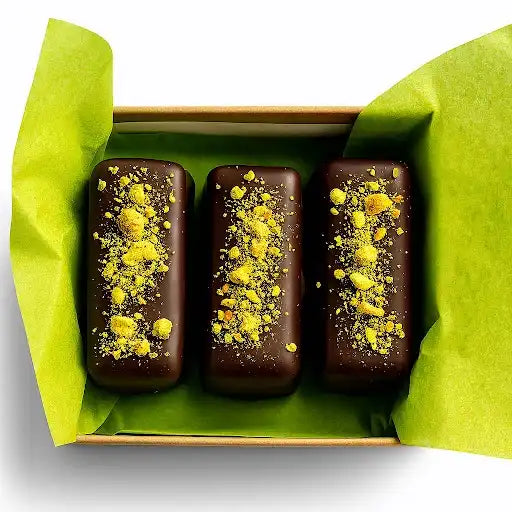
For everyone else, including most of us in our right-now lives, we built a Dubai chocolate bar at Coracao Confections that solves the problem on the shelf instead of in your kitchen. The recipe is intentionally faithful to the original sensory event (snap, soft pistachio, audible crunch, sesame anchor) and intentionally upgraded on the parts where the original cuts corners.
What's in it: 81% dark organic chocolate shell made from heirloom cacao, organic pistachio filling, crisped quinoa for the crunch (gluten-free, no wheat kataifi), toasted coconut, organic tahini, no refined sugar, no dairy. One of the only Dubai-style bars on the global market that is USDA Organic, Fair Trade Certified, gluten-free, soy-free, and 100% plant-based, without the experience suffering for it.
For the maker who reads the label: we use crisped quinoa rather than wheat kataifi for two reasons. One, it makes the bar safe for the celiac and gluten-sensitive part of our community (about 20% of Coracao customers). Two, quinoa shatters with a crispness that competes with toasted phyllo on texture but adds a faintly nutty, almost popcorn-like note that we like with pistachio. It is a substitution we tested for 18 months before launching.

81% dark chocolate shell, organic pistachio filling with crisped quinoa for the crunch (no wheat kataifi). One of the only Dubai bars in the world that is USDA Organic, Fair Trade, Gluten-Free, and 100% plant-based.
Worth noting: pistachio prices climbed 30-40% globally through 2024-2025 as Dubai chocolate demand outpaced supply, which is why many of the imported viral bars now ship at $18-$22 each. Our $6.99 price holds because we work with our own fair-trade cacao supply and source our pistachios direct from a single grower partnership in California's Central Valley.
07Adapting Dubai Chocolate Ingredients for Diets and Allergies
Dubai chocolate as the Fix bar makes it contains five of the eight major US allergens (gluten, tree nuts, sesame, dairy, soy). Of those, two are intrinsic (pistachios, sesame). The other three are choices.
Vegan and Dairy-Free
Swap the milk chocolate for a quality dark chocolate (60-72% works best). Replace the butter for toasting with virgin coconut oil. Choose a pistachio cream that is plant-based; most premium Italian and Lebanese versions already are, but check the label for "milk powder." Tahini and pistachios are already vegan. The resulting bar is indistinguishable from the original on flavor, sometimes superior because dark chocolate carries the pistachio better.
Gluten-Free
Kataifi is wheat-based, so this is the swap that takes work. Three options that we have tested: crisped quinoa (cleanest swap, what Coracao uses), puffed rice cereal (lightest crunch), or Geefree gluten-free phyllo (most authentic but harder to find). Toast all three the same way you would kataifi. Quinoa goes from "puffed" to "toasted" faster than wheat kataifi, about 6-7 minutes, so watch closely.
Refined-Sugar-Free
Use a dark chocolate sweetened with coconut sugar, monk fruit, or stevia (Hu Kitchen, Lily's, and Coracao all make options). Choose a pistachio cream made without added sugar (these exist, look for "100% pistachio") and add a tablespoon of maple syrup if the filling needs a touch of sweetness. The bar will not be Halloween-candy sweet; it will be dessert sweet, which is closer to what the original tastes like anyway.
Nut Allergy (Beyond Pistachio)
If pistachios are off the table, this bar cannot really exist; pistachios are the star ingredient. If you are managing a tree-nut allergy that excludes pistachios but allows sunflower or pumpkin seeds, a sunflower-seed butter with a pinch of matcha for color can deliver a green, smooth filling that mimics the pistachio role, though the flavor is meaningfully different. We would call that a "Dubai-inspired bar" rather than a Dubai chocolate.
08How to Store Each Ingredient
Once you have the four essentials in your kitchen, here is how to keep them at their best. Two of the four are perishable once opened, which is the part most recipes skip.
- Chocolate: sealed in a cool, dry, dark place at 60-65°F (15-18°C). Do not refrigerate, which causes condensation and "sugar bloom." Properly stored, dark chocolate keeps for 12+ months, milk for 8-10.
- Pistachio cream: refrigerated after opening, used within 8-10 weeks. The oil will separate; stir before each use. Bring to room temperature before working with it.
- Kataifi: frozen until the day you use it (up to 6 months). Once defrosted, use within 2-3 days. Do not refreeze.
- Tahini: stable at room temperature for 4-6 months opened (the high oil content acts as a preservative). Refrigerate in hot climates. Stir before each use.
- Finished bars: airtight container in the fridge, 2-3 weeks. The kataifi softens slightly after day 7, so the texture peaks early. Bring to room temperature 10 minutes before eating; cold-from-the-fridge mutes the flavor.
09Frequently Asked Questions
Where do I buy kataifi pastry?
Greek and Middle Eastern grocery stores carry it frozen year-round, usually in a 1-pound box. Whole Foods reliably stocks Apollo or Athens brand in the freezer aisle. Amazon ships frozen kataifi nationwide via Apollo and Athens, with two-day delivery in cold packs. If you live near a Mediterranean bakery, that is the freshest source and often the cheapest. Look for the spellings "kataifi," "kadayif," or "kadayıf"; all three refer to the same shredded phyllo pastry.
What pistachio cream brand is closest to Fix Dessert Chocolatier's?
The Fix bar uses a high-percentage Sicilian or Turkish pistachio paste. The closest off-the-shelf match in the US is Bronte DOP pistachio cream from Sicily ($30+ per jar, available via Gustiamo and Eataly), with Babbi Pistacchio (Italian, on Amazon) and Mymouné Pistachio Spread (Lebanese, at Whole Foods) as more affordable options. Look for jars where pistachios are listed first and the color is muted olive-green rather than neon. Costco has been stocking 32 oz tubs of Dubai-style pistachio cream seasonally.
Can I substitute tahini in Dubai chocolate?
You can, but you will lose the bar's defining anchor. Tahini's job is to add a savory, slightly bitter bass note that prevents the filling from reading as one-dimensionally sweet. If sesame is off-limits, the closest substitute is a tablespoon of a mild, smooth nut butter like cashew or sunflower-seed butter, plus a pinch of salt to compensate for the missing savory note. The bar will still be good; it will not taste exactly like the original. Honestly, if you can use tahini, use it; almost everyone who skips this step reports the bar feels "flat."
What's the difference between kataifi and phyllo?
Kataifi is shredded phyllo, made from the same dough but extruded through tiny holes to form thin vermicelli-like strands. Phyllo (or filo) is the same dough rolled paper-thin into sheets. Both are wheat-based, both Greek-Levantine in origin. For Dubai chocolate, you need kataifi specifically; regular phyllo sheets will not deliver the same crunch even if you finely shred them yourself. Look for kataifi in the freezer aisle near the phyllo sheets, in a smaller box.
Is Dubai chocolate vegan?
The original Fix Dessert Chocolatier version is not vegan, because it uses a milk chocolate shell, butter for toasting the kataifi, and sometimes milk powder in the pistachio cream. A vegan adaptation is straightforward: swap milk chocolate for dark, butter for coconut oil, and choose a pistachio cream without milk powder (most premium Italian and Lebanese versions are already plant-based). Coracao's Dubai Chocolate Bar is 100% plant-based by design.
Is Dubai chocolate gluten-free?
The traditional version is not, because kataifi is wheat-based shredded phyllo. Gluten-free adaptations use crisped quinoa, puffed rice cereal, or Geefree's gluten-free phyllo. Texture-wise, crisped quinoa is the closest swap and is what Coracao's bar uses. Geefree's product is the most authentic but harder to find; check their direct-to-consumer site if you want it.
Can I make Dubai chocolate without chocolate molds?
Yes, though the result will look more like a chocolate slab than a thick rectangular bar. Two methods work. First, spread a 3 mm layer of tempered chocolate on a parchment-lined baking sheet, refrigerate until set, layer the filling on top, then pour and spread another 3 mm of chocolate on top and refrigerate again; cut into rectangles once fully firm. Second, use a standard loaf pan lined with parchment; the proportions will be off but the technique works. The thick palm-sized bar shape that Fix made famous specifically needs silicone bar molds (around 5 x 2.5 x 1 inch), available on Amazon for around $12.
How long do the ingredients last once I buy them?
Chocolate: 12+ months sealed. Pistachio cream: 8-10 weeks refrigerated after opening. Kataifi: 6 months frozen, 2-3 days once defrosted. Tahini: 4-6 months opened at room temperature, longer in the fridge. If you are planning to make Dubai chocolate more than once a quarter, the cheapest strategy is buying kataifi in bulk and freezing portions, then sourcing fresh pistachio cream each time.
10Quick Recap (For the Shopping Trip)
If you only remember one paragraph from this guide, make it this one. Dubai chocolate ingredients are quality chocolate, pistachio cream, kataifi, and tahini. Source the chocolate from a baking-supply or specialty store with real cocoa butter on the label. Source the pistachio cream from a Middle Eastern grocer, Whole Foods, or Amazon, picking a brand where pistachios are listed first and the color leans olive-green. Source kataifi frozen from any Greek or Mediterranean grocery or via Amazon, defrost overnight in the fridge, and toast it to deep gold before mixing. Source tahini single-origin from Soom or Seed + Mill at any Whole Foods. After you have the ingredients, the explainer guide shows how the four work together in the original viral bar.
Or, if all that reads like a half-Saturday project, the same flavor in a finished bar lives one click away.
Bars Built for the Bar Maker
Three Coracao chocolate bars that play well with home-made Dubai chocolate, or stand alone as their own thing.

- Zero added sugar, keto-friendly
- Works as the bar shell
- USDA Organic, plant-based

- Crunchy almond + flaky sea salt
- Pairs well with pistachio
- Vegan, gluten-free

- Plant-based milk chocolate
- Crisped quinoa, no wheat
- Sugar-free
Skip the kitchen, keep the experience
Coracao's Dubai Chocolate Bar takes the four-ingredient blueprint and rebuilds it with 81% dark organic chocolate, real organic pistachios, crisped quinoa for the crunch (no wheat kataifi), and a touch of tahini. One of the only Dubai bars in the world that is USDA Organic, Fair Trade, gluten-free, and 100% plant-based.
Shop the Dubai Bar · $6.99
Claire Bennett
I'm Claire, a chocolate lover and artisan based in a small town where I run a tiny home kitchen dedicated to exploring everything chocolate. From single-origin dark bars to creamy ganache and handmade truffles, I find joy in working with all types of chocolate. I believe chocolate has a story, and I love bringing that story to life through humble, heartfelt creations.

Leave a comment
This site is protected by hCaptcha and the hCaptcha Privacy Policy and Terms of Service apply.