



Vegan Matcha Truffles, Ceremonial-Grade Mizuba Matcha Fudge Box
Ingredients
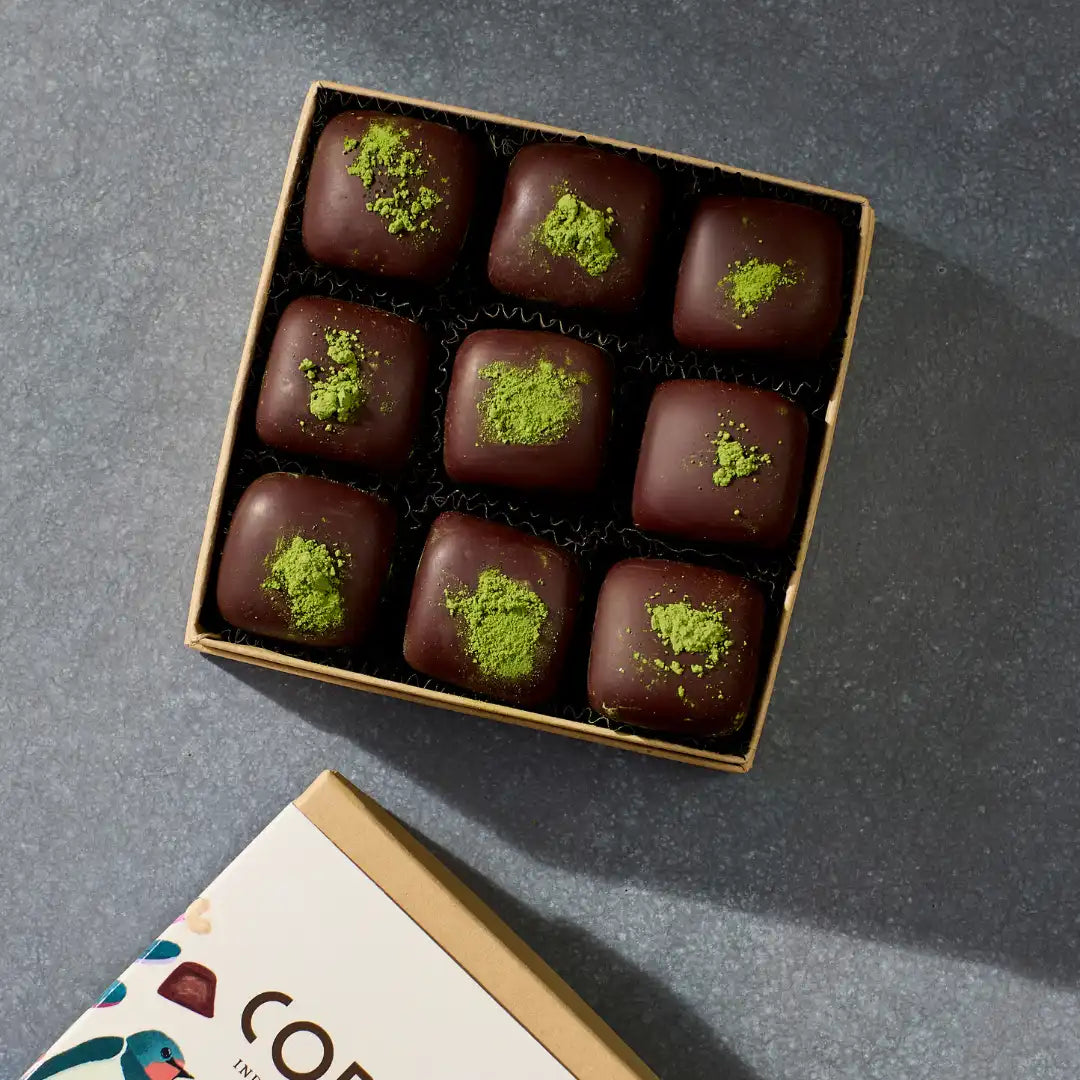
Vegan matcha truffles, hand-rolled in Berkeley from ceremonial-grade Mizuba matcha, Organic cacao, and coconut sugar. Nine matcha fudge bites in a keepsake box, the format we settled on after two years of tinkering. If you already love matcha for its grassy first note and long umami finish, these matcha truffles carry that same character into cacao instead of dairy. There is no cream, no butter, no lecithin. Cacao butter and coconut butter carry the fat. Coconut sugar carries the sweetness. Matcha carries everything else.
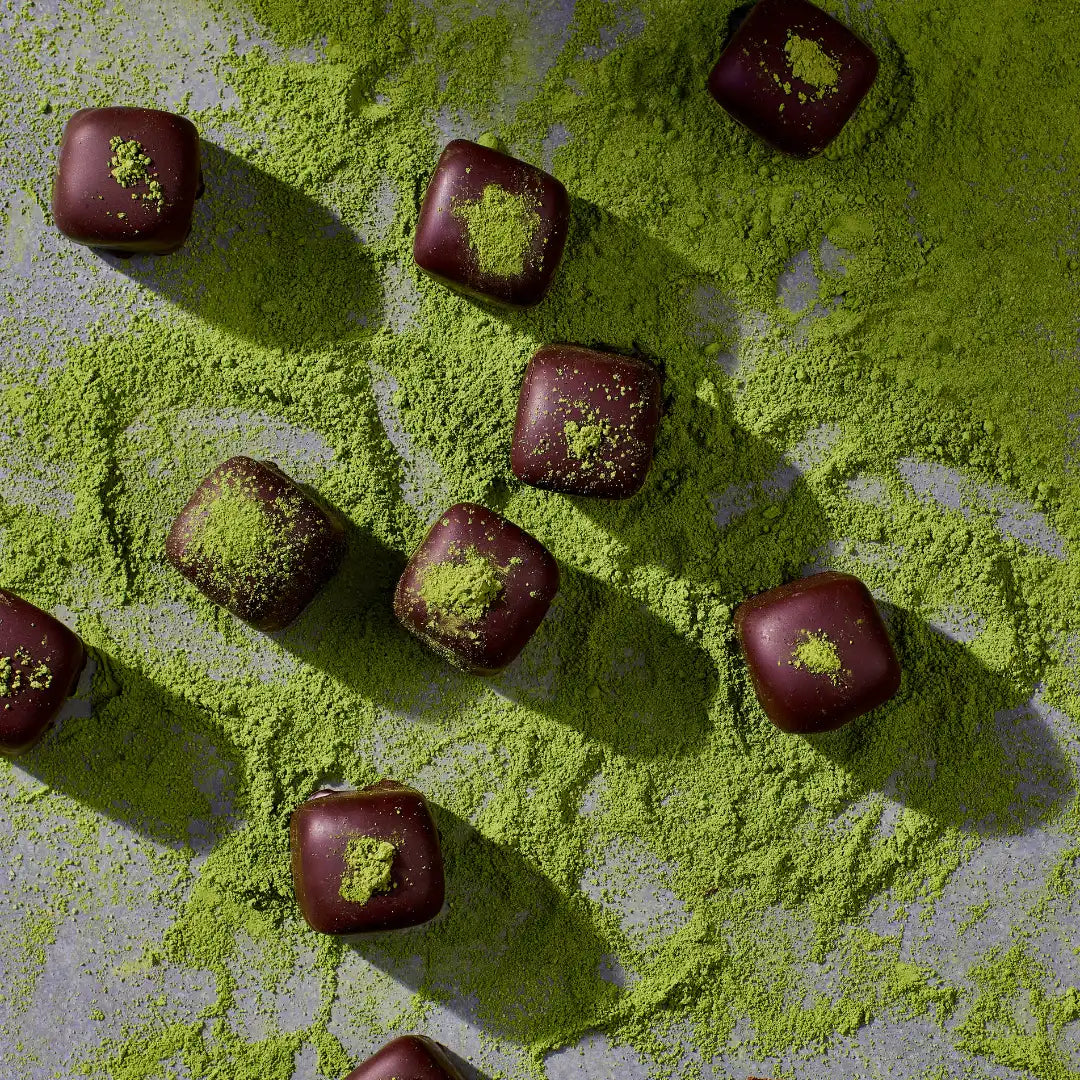
A single truffle is roughly two bites, thumb-sized, dusted, the green pulled slightly darker where the cacao butter has bloomed against the powder. We portion 9 per box because that is what fits neatly in the tea ritual: three for you, three for a friend, three for the tin on the counter. Ships flat-rate from Berkeley, California.
What makes these vegan matcha truffles different, the Mizuba partnership
Ceremonial-grade shade-grown from Uji, Japan
We do not source matcha through a broker. Every kilo of green tea in these matcha chocolate truffles comes from Mizuba Tea Company, a small Portland-based importer working directly with a family-run tea garden in the Uji region of Kyoto, Japan. Uji is the origin story for Japanese green tea, a river valley south of Kyoto that has grown tea since the 12th century, where the fog off the Uji River still shades the fields at dawn.
What lands in our Berkeley factory is ceremonial-grade shade-grown matcha: leaves grown under bamboo screens for the final three weeks before harvest, hand-picked, steamed, dried, deveined, then stone-milled into a powder so fine it feels like talc between the fingers. Shade-growing is the whole game. Denied direct sun, the tea plant floods its leaves with chlorophyll and L-theanine, the amino acid responsible for matcha's savory, almost broth-like umami. Sun-grown culinary matcha lacks both. The colour is duller, the finish is bitter, the umami is thin.
You can taste that difference the moment a Mizuba truffle warms on the tongue. The green comes forward first, grassy, wet-stone, almost oceanic, then the cacao meets it in the middle. There is no artificial green flavour on the label because none is needed. There is also no milk powder to mute the tea, no soy lecithin to slip between the fat and the water. This is the closest we know how to get to eating matcha powder itself, only slower.
Nine hand-rolled fudge bites
Berkeley small means we make these matcha truffles in runs of roughly 200 boxes at a time, roll them the same week they ship, and never sit on matcha inventory. Matcha oxidises. We refuse to sell it stale.
Ingredients, ceremonial-grade matcha, Organic cacao, coconut sugar
Mizuba ceremonial matcha
- Matcha*, Mizuba Tea Co. ceremonial-grade, shade-grown, Uji region of Japan, stone-milled.
Organic cacao
- Cacao*†, Organic criollo-hybrid beans, fermented and sun-dried at origin, roasted low in small batches at our Berkeley factory.
- Cacao Nibs*, same lot as the cacao, cracked and winnowed for that faint crunch inside the fudge.
Coconut sugar & cacao butter
- Coconut Sugar*, low-glycemic, unrefined, tapped from coconut blossom nectar.
- Cacao Butter*†, cold-pressed from the same cacao, no deodorising, no bleaching.
- Coconut Butter*, whole-flesh coconut, ground to a paste, keeps the truffle centre creamy without dairy.
- Vanilla Bean*, Madagascar bourbon vanilla, whole pod, scraped by hand.
- Himalayan Crystal Salt, a pinch, mostly to lift the matcha's umami note.
*Organic. †Fair Trade Certified™.
Tasting notes
Grassy first note
Spring-cut lawn, wet river stone, the smell that hits when you open a fresh tin of matcha.
Umami mid-palate
Savoury and broth-like, the L-theanine signature of shade-grown leaf.
Sweet chocolate finish
Coconut-sugar warmth and Organic cacao roll in behind the tea.
Lingering matcha bitterness
A clean tannic pull at the back, the way real matcha should finish.
No artificial green flavour
Nothing masking, nothing lifting; just the leaf, the bean, and the sugar.
Ceremonial vs culinary matcha, what grade we use
Matcha grade is not marketing. It is a real distinction based on which harvest the leaf came from and how the plant was grown. Ceremonial-grade matcha is first-harvest (May), shade-grown, made from the youngest top leaves, vivid jade, smooth, sweet enough to whisk with water and drink straight. It is what a tea master would use for koicha. Culinary matcha is later-harvest, often sun-grown, made from older leaves, duller in colour, coarser in texture, aggressively bitter, and priced to survive being masked by milk and sugar in a latte or a brownie.
Almost every “matcha chocolate” you find on the shelf uses culinary. It is why the green fades to army-drab and the flavour tastes vaguely of spinach and confectioner's sugar. We use ceremonial-grade because our matcha truffles have nowhere to hide, no dairy, no filler, no whipped topping. If the matcha is not good enough to drink, it is not good enough to fold into cacao butter.
How to enjoy, pairings, gifting, storage
Pairings
A cup of genmaicha or sencha with one truffle is the intended experience, the toasted rice of a genmaicha meets the caramel in the coconut sugar, the sencha echoes the matcha in the fudge. A well-made oat-milk matcha latte on the side turns it into a Kyoto café moment.
Gifting angle
Nine truffles is the right count for tea people, enough to share, small enough to feel considered. Common gifting occasions: matcha-obsessed friend's birthday, hostess gift for a tea ceremony, thank-you for a green-tea drinker who “does not want more chocolate.” We ship the box unadorned and clean-labelled; add a note at checkout and we will handwrite it.
Storage (matcha is oxidation-sensitive)
Matcha is oxidation-sensitive. Keep the box below 68°F, away from direct light, sealed between servings. Best within 4 weeks of arrival. The truffles will still be safe well after that; the matcha will simply start to lose the vivid green edge and the umami will soften.
Nutrition facts & allergens
| Per truffle (17 g) | Amount |
|---|---|
| Calories | ~85 |
| Total fat | ~6 g |
| Total carbohydrate | ~7 g |
| Sugars (coconut sugar) | ~5 g |
| Protein | ~1 g |
| Caffeine (from matcha) | ~15-20 mg |
Values approximate; per-truffle. Placeholder pending final lab panel.
Sourcing, Uji-region matcha + Organic cacao
The matcha comes from Mizuba Tea Company's Uji-region tea garden partnership, direct-trade, single-origin, first-harvest, shade-grown for the last three weeks. The cacao is Organic criollo-hybrid, fair-trade certified, purchased through farmer cooperatives at prices above the Fair Trade minimum. The coconut sugar and coconut butter come from small-holder farms in Southeast Asia; the vanilla is Madagascar bourbon, whole-pod, scraped in our factory. Nothing on the label is a mystery. Everything on the label is organic.
Frequently asked questions
Does it contain caffeine? How much per truffle?
Yes, roughly 15-20 mg of caffeine per truffle from the matcha. That is about a third of a cup of green tea, or a quarter of a shot of espresso. Ceremonial matcha runs higher in L-theanine than most green teas, which softens the caffeine curve, most people feel it as calm alertness rather than a jolt.
Is it dairy-free?
Yes. There is no milk, no butter, no whey, no casein. The creamy centre is cacao butter and coconut butter, which give the mouthfeel of a truffle without any dairy. Also soy-free and gluten-free.
What grade of matcha do you use?
Ceremonial-grade shade-grown matcha from Mizuba Tea Company, Uji region of Japan. First-harvest, stone-milled, single-origin. It is the same grade you would whisk into a bowl of hot water for a tea ceremony, not culinary matcha.
How long does it stay fresh?
Best within 4 weeks of arrival. Matcha oxidises when exposed to heat, light, and air, and the flavour softens as it does. Store the box below 68°F, out of direct sunlight, sealed between servings. The truffles remain safe well past 4 weeks; the matcha simply loses its edge.
Shipping & gifting
Ships flat-rate from Berkeley, California. Rolled the week they ship, we do not warehouse finished truffles. Free-form gift note at checkout, handwritten. If you are shipping to a warm climate in summer, we add an ice pack automatically.
Vegan | 100% Plant-Based | Organic | Fair-Trade Cacao | Soy-Free | Gluten-Free | Berkeley small
Choose options
Crafted with Organic, Fair-Trade Ingredients
Discover the natural ingredients that make our products special

Cacao Nibs

Cacao

Cacao Butter

Himalayan Salt
USDA Organic Certified Ingredients
All Cocoa Used in Our Chocolate is Fair Trade Certified

100% Vegan & Plant-Based With No Exceptions

Lower Glycemic & Environmentally Friendly Coconut Sugar

All Ingredients Used in Our Treats Are Gluten-Free

Transparent Sourcing
CACOCO & Coracao’s cacao is sourced from the central Huallaga Valley in the San Martin region of Peru, a region known for producing some of the worlds finest criollo cacao. We source our Cacao from Acopagro, a cooperative of more than 2,000 small organic cacao producers. In addition to cacao production, Acopagro promotes agroforestry systems and regenerative farming practices to keep replenishing the land. Furthermore, Acopagro manages the conservation of 108,000 acres of forest in the Huallaga region. Our Cacao is organically grown where the air is fresh and the soil is rich. We strive to source from heirloom varieties native to the region, known for superior flavor, aromatics, and contribution to local biodiversity. All of our farming partners are paid Fair Trade wages or above.